Is Virtual Memory Necessary
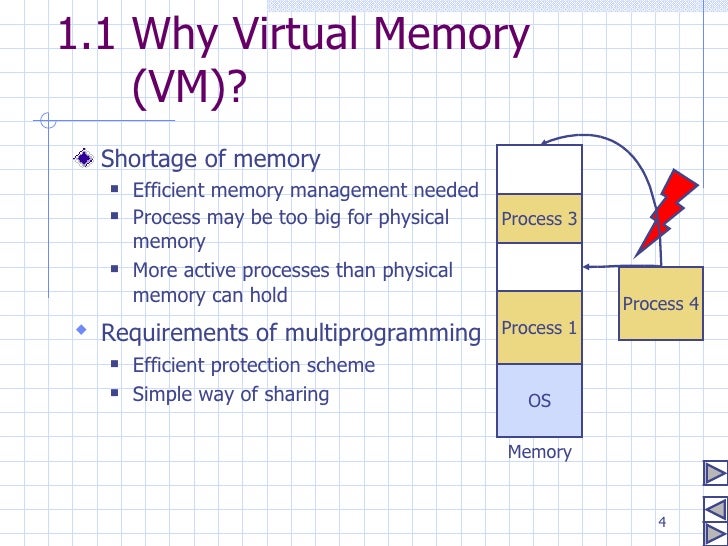
Posted : admin On 11.09.2019So virtual memory is no longer needed to page or swap memory. However, the other side of virtual memory is to create an address space for each process. The virtual memory that the application sees starts with address 0, and each program sees only its own data and program and cannot see the contents of the address space owned by other programs.
Is Virtual Memory Necessary To Be
How to Manage Virtual Memory Pagefile in Windows 10is a memory management scheme by which a PC stores and retrieves data from secondary storage for use in main memory. In this scheme, the operating system retrieves data from secondary storage in same-size blocks called pages. Paging is an important part of virtual memory implementations in modern operating systems, using secondary storage to let programs exceed the size of available physical memory.For simplicity, main memory is called 'RAM' (abbreviated from 'random-access memory') and secondary storage is called 'disk' (a shorthand for 'hard disk drive'), but the concepts do not depend on whether these terms apply literally to a specific computer system.is a memory management technique that is implemented using both hardware and software. It maps memory addresses used by a program, called virtual addresses, into physical addresses in computer memory. Main storage as seen by a process or task appears as a contiguous address space or collection of contiguous segments. Windows manages virtual address spaces and the assignment of real memory to virtual memory. Address translation hardware in the CPU, often referred to as a memory management unit or MMU, automatically translates virtual addresses to physical addresses.
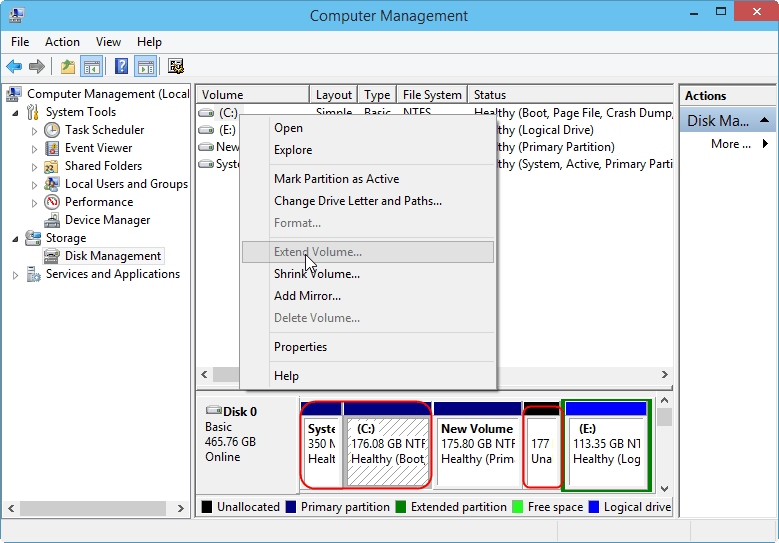
A) Uncheck the Automatically manage paging file size for all drives box. (see screenshot below step 6F)B) Select a drive (ex: C: ) you want to either set a custom size or add a paging file. (see screenshot below step 6F)C) Select (dot) Custom size. (see screenshot below step 6F)D) Enter the Initial size (minimal) you want in MB (1024 MB = 1 GB) for the paging file on the selected drive.
(see screenshot below step 6F)E) Enter the Maximum size you want in MB (1024 MB = 1 GB) for the paging file on the selected drive. (see screenshot below step 6F)F) Click/tap on the Set button. (see screenshot below).
Virtual memory combines active and inactive memory on to form a large range of contiguous addresses.In, virtual memory (also virtual storage) is a technique that provides an 'idealized abstraction of the storage resources that are actually available on a given machine' which 'creates the illusion to users of a very large (main) memory.' The computer's, using a combination of hardware and software, maps used by a program, called, into physical addresses in., as seen by a process or task, appears as a contiguous or collection of contiguous. The operating system manages and the assignment of real memory to virtual memory. Address translation hardware in the CPU, often referred to as a or MMU, automatically translates virtual addresses to physical addresses. Software within the operating system may extend these capabilities to provide a virtual address space that can exceed the capacity of real memory and thus reference more memory than is physically present in the computer.The primary benefits of virtual memory include freeing applications from having to manage a shared memory space, increased security due to memory isolation, and being able to conceptually use more memory than might be physically available, using the technique of. Contents.Properties Virtual memory makes application programming easier by hiding of physical memory; by delegating to the kernel the burden of managing the (eliminating the need for the program to handle explicitly); and, when each process is run in its own dedicated address space, by obviating the need program code or to access memory with.can be considered a generalization of the concept of virtual memory.Usage Virtual memory is an integral part of a modern; implementations usually require hardware support, typically in the form of a built into the.
While not necessary, and can employ hardware support to increase performance of their virtual memory implementations. Consequently, older operating systems, such as those for the of the 1960s, and those for personal computers of the early to mid-1980s (e.g., ), generally have no virtual memory functionality– though notable exceptions for mainframes of the 1960s include:. the for the. for the (software based virtual memory without hardware support). for the., and for the. for the.
the for the /46and the operating system for the is an example of a personal computer operating system of the 1980s that features virtual memory.During the 1960s and early 70s, computer memory was very expensive. The introduction of virtual memory provided an ability for software systems with large memory demands to run on computers with less real memory. The savings from this provided a strong incentive to switch to virtual memory for all systems. The additional capability of providing virtual address spaces added another level of security and reliability, thus making virtual memory even more attractive to the market place.Most modern operating systems that support virtual memory also run each in its own dedicated. Each program thus appears to have sole access to the virtual memory. However, some older operating systems (such as and ) and even modern ones (such as ) are that run all processes in a single address space composed of virtualized memory.and other special-purpose computer systems that require very fast and/or very consistent response times may opt not to use virtual memory due to decreased; virtual memory systems trigger unpredictable that may produce unwanted and unpredictable delays in response to input, especially if the trap requires that data be read into main memory from secondary memory. The hardware to translate virtual addresses to physical addresses typically requires significant chip area to implement, and not all chips used in embedded systems include that hardware, which is another reason some of those systems don't use virtual memory.History In the 1940s and 1950s, all larger programs had to contain logic for managing primary and secondary storage, such as.
Virtual memory was therefore introduced not only to extend primary memory, but to make such an extension as easy as possible for programmers to use. To allow for and, many early systems divided memory between multiple programs without virtual memory, such as early models of the via.The concept of virtual memory was first developed by German at the in 1956 in his doctoral thesis, Logical Design of a Digital Computer with Multiple Asynchronous Rotating Drums and Automatic High Speed Memory Operation; it described a machine with 6 100-word blocks of primary core memory and an address space of 1,000 100-word blocks, with hardware automatically moving blocks between primary memory and secondary drum memory. Was first implemented at the as a way to extend the 's working memory by combining its 16,384 words of primary with an additional 98,304 words of secondary. The first Atlas was commissioned in 1962 but working prototypes of paging had been developed by 1959.
( p2) In 1961, the independently released the first commercial computer with virtual memory, the, with rather than paging.Before virtual memory could be implemented in mainstream operating systems, many problems had to be addressed. Dynamic address translation required expensive and difficult-to-build specialized hardware; initial implementations slowed down access to memory slightly. There were worries that new system-wide algorithms utilizing secondary storage would be less effective than previously used application-specific algorithms. By 1969, the debate over virtual memory for commercial computers was over; an research team led by showed that their virtual memory overlay system consistently worked better than the best manually controlled systems. Throughout the 1970s, the IBM 370 series running their virtual-storage based operating systems provided a means for business users to migrate multiple older systems into fewer, more powerful, mainframes that had improved price/performance. The first to introduce virtual memory was the Norwegian; during the 1970s, other minicomputers implemented virtual memory, notably models running.Virtual memory was introduced to the architecture with the of the processor, but its segment swapping technique scaled poorly to larger segment sizes.
The introduced paging support underneath the existing layer, enabling the page fault exception to chain with other exceptions without. However, loading segment descriptors was an expensive operation, causing operating system designers to rely strictly on paging rather than a combination of paging and segmentation.Paged virtual memory. This section needs additional citations for. Unsourced material may be challenged and removed.Find sources: – ( December 2010) Nearly all current implementations of virtual memory divide a into, blocks of contiguous virtual memory addresses. Pages on contemporary systems are usually at least 4 KiB in size; systems with large virtual address ranges or amounts of real memory generally use larger page sizes.
Page tables are used to translate the virtual addresses seen by the application into used by the hardware to process instructions; such hardware that handles this specific translation is often known as the. Each entry in the page table holds a flag indicating whether the corresponding page is in real memory or not.
If it is in real memory, the page table entry will contain the real memory address at which the page is stored. When a reference is made to a page by the hardware, if the page table entry for the page indicates that it is not currently in real memory, the hardware raises a, invoking the paging supervisor component of the.Systems can have one page table for the whole system, separate page tables for each application and segment, a tree of page tables for large segments or some combination of these.
If there is only one page table, different applications use different parts of a single range of virtual addresses. If there are multiple page or segment tables, there are multiple virtual address spaces and concurrent applications with separate page tables redirect to different real addresses.Some earlier systems with smaller real memory sizes, such as the, used instead of page tables in memory for address translation.Paging supervisor This part of the operating system creates and manages page tables. If the hardware raises a page fault exception, the paging supervisor accesses secondary storage, returns the page that has the virtual address that resulted in the page fault, updates the page tables to reflect the physical location of the virtual address and tells the translation mechanism to restart the request.When all physical memory is already in use, the paging supervisor must free a page in primary storage to hold the swapped-in page. The supervisor uses one of a variety of such as to determine which page to free.Pinned pages Operating systems have memory areas that are pinned (never swapped to secondary storage). Other terms used are locked, fixed, or wired pages. For example, mechanisms rely on an array of pointers to their handlers, such as completion. If the pages containing these pointers or the code that they invoke were pageable, interrupt-handling would become far more complex and time-consuming, particularly in the case of page fault interruptions.
Hence, some part of the page table structures is not pageable.Some pages may be pinned for short periods of time, others may be pinned for long periods of time, and still others may need to be permanently pinned.